

The Combinatorial Void
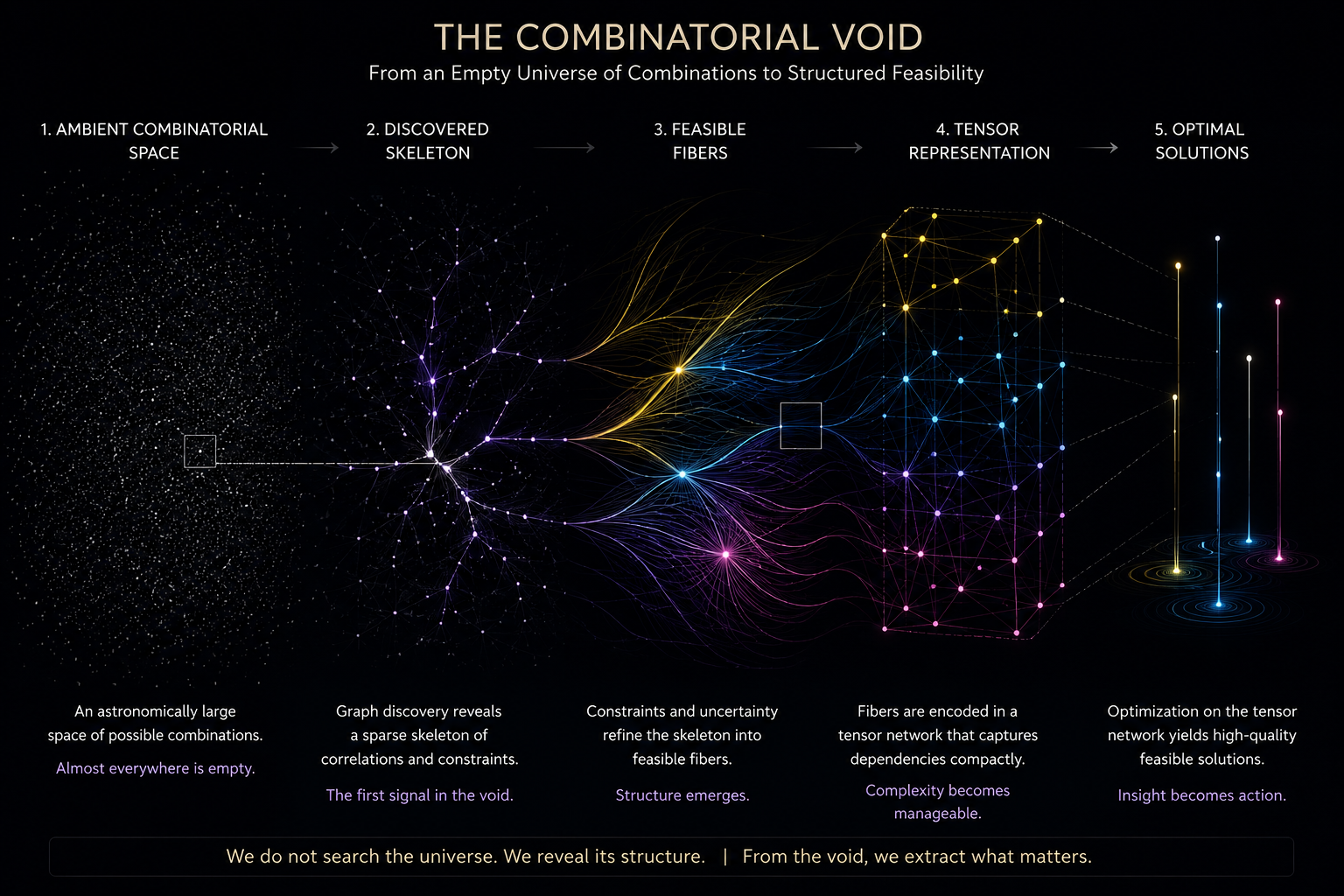
When almost every possible solution is impossible, searching the solution space may be the wrong place to start.
Many of the most important computational problems in physical systems have the same underlying anatomy.
They combine discrete decisions—turn a generator on, point a satellite at a target, assign a task to a GPU, select a protein conformation—with continuous, nonlinear physical constraints governing which combinations can actually exist.
The resulting spaces are enormous.
A mid-sized power-grid problem can generate a nominal decision space on the order of (10^{3000}). A satellite constellation tracking thousands of objects over time produces vastly more possibilities. Similar explosions appear in protein folding, data-center scheduling, quantum error correction and multi-agent coordination.
But dimensionality is only part of the problem.
The much deeper problem is that almost all of these mathematically possible configurations are physically impossible.
Kirchhoff's laws invalidate power-grid configurations. Orbital geometry and optical visibility eliminate satellite assignments. Steric collisions rule out protein conformations. Thermal limits constrain GPU placement. Parity conditions eliminate quantum error patterns. Kinematics, communication and resource constraints rule out multi-agent strategies.
The physically feasible solutions therefore form a thin and highly structured subset inside an astronomical Cartesian space.
The rest is the combinatorial void.
Why this matters
Many advanced computational techniques—including tensor methods and potentially quantum algorithms—derive their power from representing or sampling extremely large spaces efficiently.
But compression alone does not solve the problem if the algorithm does not know where meaningful information resides.
A Tensor Train sampling blindly from a (10^{3000})-state power-grid space will overwhelmingly encounter configurations that violate the underlying physics. Instead of learning the structure of good solutions, the approximation becomes dominated by infeasibility.
The problem therefore precedes optimization:
How can we discover the structure of the physically meaningful space before trying to represent or search it?
A different computational architecture
The approach developed at Prime Radiant begins by representing the system as a heterogeneous spatio-temporal graph.
Nodes represent physical or logical entities. Edges encode interactions. Time creates an additional layer of dependencies. Feasibility is then defined not as an abstract penalty, but by the actual physical, temporal and topological constraints acting across this graph.
Instead of immediately solving the full nonlinear problem, a computationally inexpensive proxy is used to produce a first map of where important decisions may lie.
This creates a candidate combinatorial skeleton.
But the proxy is not trusted blindly. Its uncertain regions are explicitly separated from its high-confidence structure. The resulting space is partitioned hierarchically, and increasingly expensive evaluations of the true nonlinear physics are used to sift those partitions.
Promising regions survive. Unproductive regions disappear. Ambiguous regions are explored more deeply.
Eventually the process produces something conventional random sampling cannot easily provide: a concentrated collection of strictly feasible, high-value configurations drawn from the regions where interesting solutions actually live.
These configurations can then seed a Tensor-Train representation of the objective.
The computational sequence becomes:
Graph → Proxy → Skeleton → Uncertainty → Physical Sifting → Feasible Fibers → Tensor Representation → Optimization
One architecture, different physics
An important question is whether this is merely a technique for one particular optimization problem.
The research therefore reconstructs the framework across very different domains.
In a power grid, the proxy is a linearized version of AC power flow, while the sifting stage returns to the full nonlinear Kirchhoff equations.
For satellite tasking, the graph itself changes through time as orbital propagation, illumination and optical magnitude determine which targets are physically observable.
In protein folding, feasibility is determined by steric exclusion and molecular interaction energies.
In AI data centers, communication topology interacts with nonlinear thermal constraints across thousands of GPUs.
And quantum error correction forces the architecture to change more fundamentally: ordinary continuous relaxations no longer apply because feasibility is governed by exact parity relations over a binary field. The structural proxy is therefore replaced by belief propagation and exact syndrome consistency.
The method is not tied to one particular approximation.
The deeper principle is that the representation and the proxy should follow the structure of the system being studied.
The larger question
The ambition of this research is not to claim that NP-hard combinatorial optimization has somehow disappeared.
It is to ask a different question.
When an enormous state space contains only a tiny structured region of physical or economic relevance, should computational effort be spent learning how to search the entire space faster?
Or should we first learn enough about the structure of the system that most of the space never needs to be represented at all?
That distinction may determine whether tensor methods—and eventually quantum computation—can become useful for a broad class of high-dimensional physical optimization problems.