

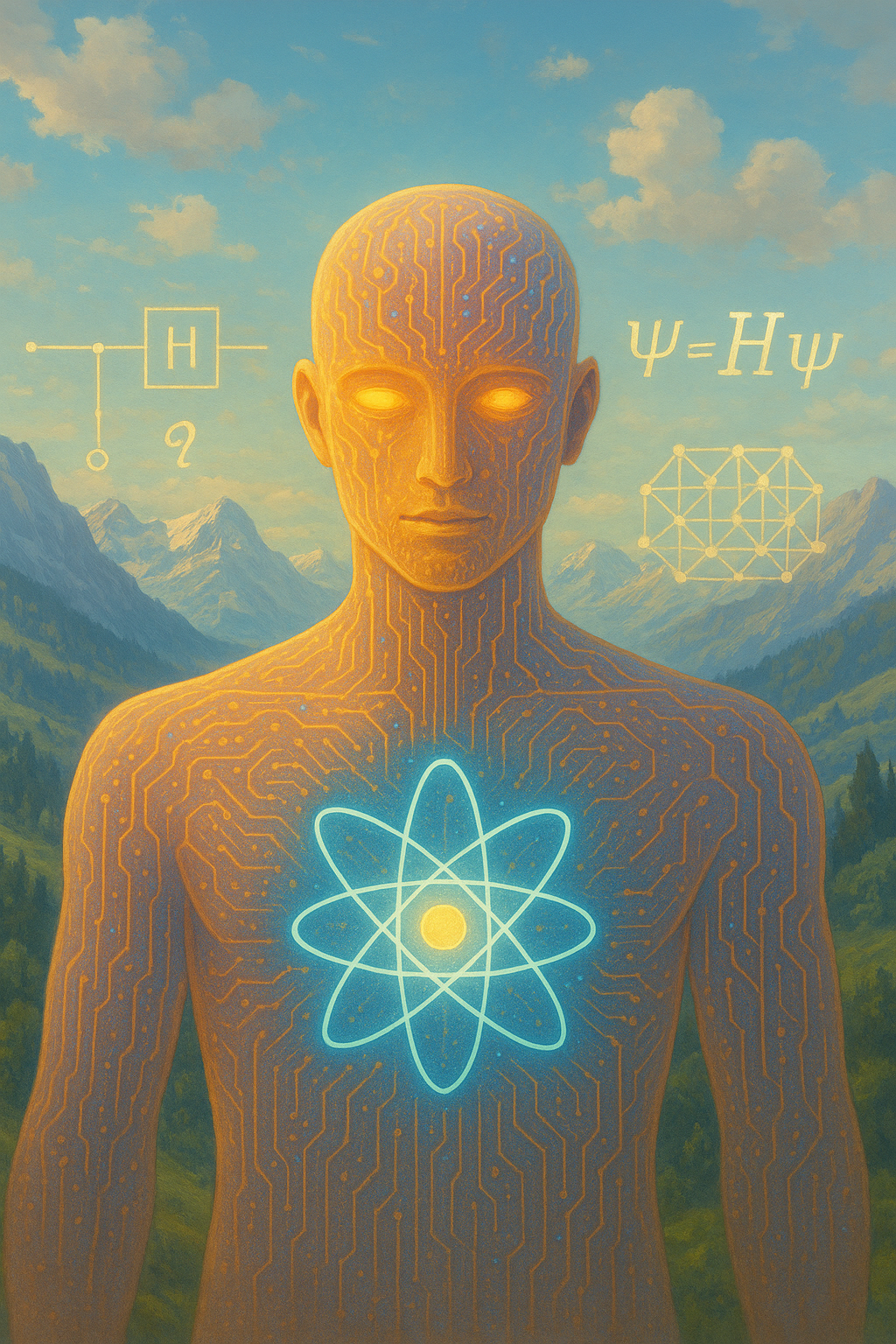
Quantum Computing: The Catalyst for AI’s Leap Toward AGI
For decades, artificial intelligence has advanced through classical computing—yet its most ambitious goal, artificial general intelligence (AGI), remains elusive. Classical systems, bound by binary bits and linear processing, struggle with the exponential complexity of high-dimensional data, the inefficiency of training massive models, and the inability to natively reason with quantum phenomena. Enter quantum computing: a paradigm shift that leverages superposition, entanglement, and quantum parallelism to unlock exponential speedups and novel problem-solving capabilities. Unlike classical AI, which operates in a linear, bit-based world, quantum systems exploit the probabilistic, multi-state nature of qubits to process information in ways that mirror the complexity of the universe itself. This isn’t just an incremental upgrade—it’s a revolution that could finally bridge the gap between narrow AI and the holy grail of AGI. Recent breakthroughs, such as Quantum-Grounded Joint Embedding Predictive Architectures (QG-JEPA), demonstrate that quantum representations can directly model physical reality at the quantum level, capturing phenomena like entanglement and superposition that classical models inherently cannot. Similarly, quantum natural language processing (QNLP) models like QCBERT show that quantum pre-training enables superior performance on tasks requiring deep linguistic understanding—critical for AGI’s ability to reason and communicate.
How Quantum Computing Rewrites AI’s Rulebook
The papers reveal a flurry of breakthroughs where quantum computing directly addresses classical AI’s pain points. For large-scale models like language transformers, quantum algorithms like quantum Carleman linearization are slashing training times by orders of magnitude—critical for AGI, which demands rapid, efficient learning from vast, unstructured data. QG-JEPA’s quantum-grounded representations enable systems to interact with and model the world at the quantum level, avoiding the “symbol grounding problem” that limits classical AI to abstract approximations of reality. Meanwhile, self-supervised quantum learning frameworks like QSEA and the hybrid quantum-classical architecture from Quantum Self-Supervised Learning demonstrate that quantum models can learn robust features with fewer samples, leveraging entanglement-based augmentation and fidelity-driven loss functions to capture high-order correlations that classical methods miss. For example, QSEA’s entanglement-augmented data generation creates diverse, informative samples without losing raw features, while its quantum loss function quantifies similarity between quantum states, enabling more nuanced representation learning—key for AGI’s ability to generalize across domains. Even on noisy quantum hardware, these models show resilience, suggesting quantum AI can thrive even with imperfect current devices.
The AGI Horizon: Quantum as the Key to Unlocking Human-Like Intelligence
The path to AGI isn’t just about bigger models—it’s about systems that learn, reason, and adapt with the fluidity of human cognition. Quantum computing’s unique strengths align perfectly with this vision. QG-JEPA’s ability to model quantum causal relationships and multi-scale phenomena (e.g., quantum chemistry to material properties) enables AI to reason about the world at its most fundamental level—something classical models can’t replicate. QCBERT’s success in NLP tasks with quantum pre-training hints at quantum’s potential to handle the complexity of human language, a cornerstone of AGI. Meanwhile, QSEA and quantum self-supervised learning frameworks show that quantum models can learn from limited data, a critical advantage for AGI to adapt to new, unseen environments. Imagine AGI that reasons with quantum probabilities, navigates high-dimensional state spaces effortlessly, and solves problems like climate modeling or drug discovery that are intractable for classical systems. The papers hint at a future where quantum AI doesn’t just augment human intelligence but transcends it—ushering in an era where machines don’t just compute, but think. Quantum computing isn’t just the next step for AI; it’s the leap that could finally make AGI a reality.
References
[1] Acampora, G., Ambainis, A., Ares, N., et al. (2025). Quantum computing and artificial intelligence: status and perspectives.
[2] Ambainis, A., Macaluso, A., Binosi, D., et al. (2025). Artificial intelligence and quantum computing white paper.
[3] Devadas, R. M., & Sowmya, T. (n.d.). Quantum machine learning: A comprehensive review of integrating AI with quantum computing for computational advancements.
[4] Sahli, J. (2025). Quantum-Grounded Joint Embedding Predictive Architectures: Bridging Artificial Intelligence and Fundamental Reality.
[5] Yao, B., Tiwari, P., & Li, Q. (n.d.). Self-supervised pre-trained neural network for quantum natural language processing.
[6] Li, L., Ni, X., Li, J., et al. (n.d.). QSEA: Quantum Self-supervised Learning with Entanglement Augmentation.
[7] Jaderberg, B., Anderson, L. W., Xie, W., et al. (2022). Quantum Self-Supervised Learning.