

HidDen combinations
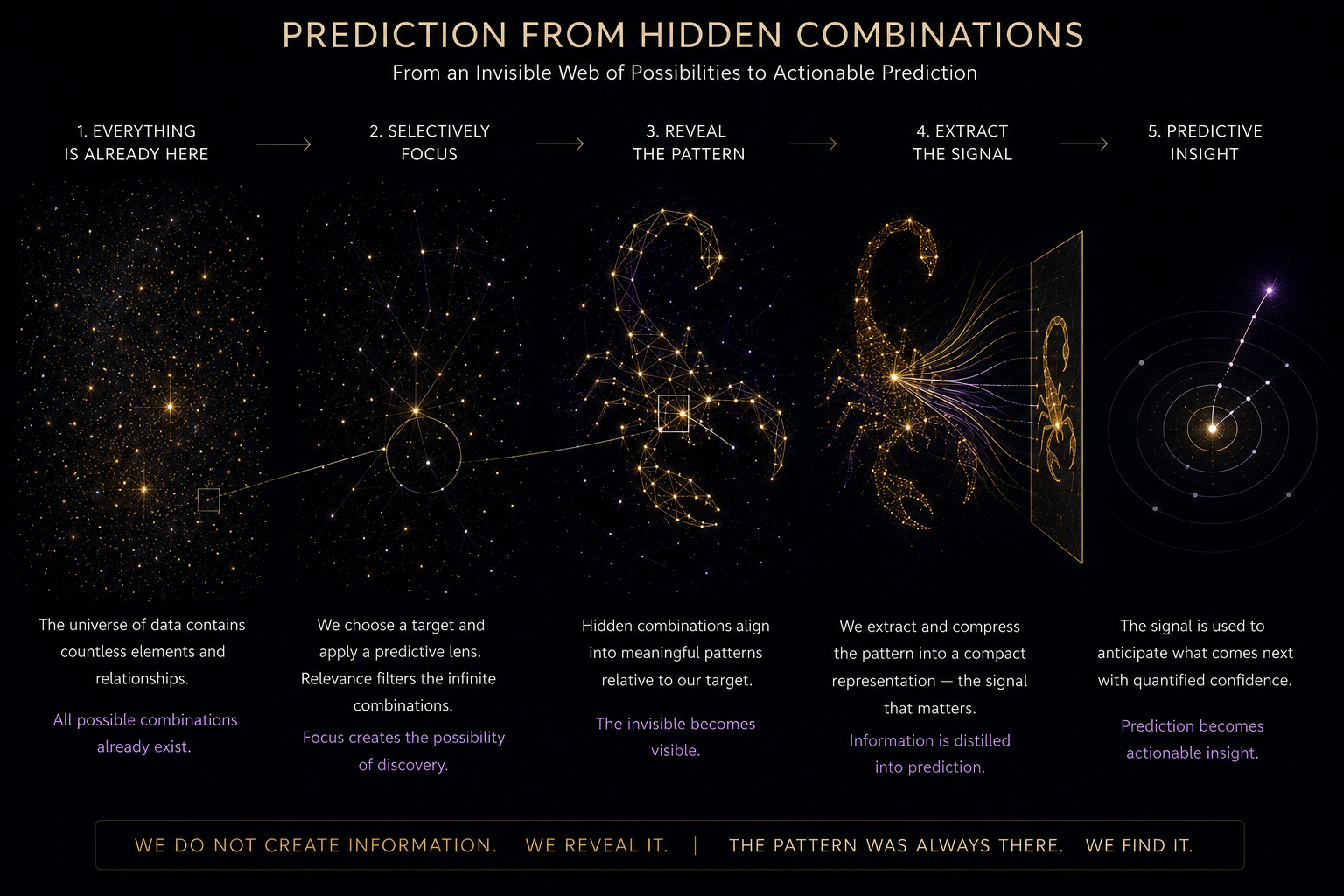
The information needed to hedge a risk may already exist. The problem is recognizing it.
Some of the risks that matter most economically are not directly tradable.
A company may be exposed to an election, a tariff decision, a regulatory change, an inflation surprise, a central-bank move or a geopolitical event. These risks can materially affect revenues, financing costs or asset values, yet there is often no conventional financial instrument whose payoff matches the exposure closely enough to provide an effective hedge.
At the same time, prediction markets increasingly trade contracts on precisely these kinds of future events.
Somewhere within that universe of contracts may be the ingredients of a hedge.
The difficulty is finding them.
Patterns hidden in words
The underlying problem is one of representation.
The information needed to construct a hedge may already exist, but it is scattered across a semantic universe: the description of the economic exposure, the language of hundreds or thousands of prediction contracts, and the economic or causal relationships connecting them.
The patterns are there, but they are hidden in words.
A portfolio manager may understand perfectly well why a particular political event creates a risk for her business. A prediction market may contain contracts related to that event, to its causes, to its consequences, and to other events exposed to the same economic forces.
But none of this initially exists in the mathematical form required by conventional portfolio theory.
The first problem is therefore not optimization.
It is to transform this semantic universe into a mathematical one—a representation in which relationships can be measured, combined and ultimately mined for hedging value.
From semantic structure to financial structure
This is where artificial intelligence becomes interesting.
Not as a replacement for financial mathematics, but as a bridge between different representations of the same economic world.
Prime Radiant's research uses language-model reasoning to explore the relationship between a risk described in ordinary language and a changing universe of event contracts. That semantic structure is then transformed into a consistent probabilistic representation from which financial engineering can take over.
The architecture crosses several disciplines:
Economic Risk → Semantic Structure → Probabilistic Structure → Portfolio Construction → Market Execution
Each transformation reveals information that was difficult to see in the representation before it.
The objective is not simply to find prediction contracts that sound related to the risk.
It is to discover the structure across those relationships that makes a collection of contracts behave as a hedge.
The obvious pattern is not always the useful one
That distinction produces some counterintuitive results.
The prediction contract that appears most obviously related to an economic exposure need not be the contract with the greatest hedging value.
Several highly relevant contracts may all express essentially the same underlying information. Another, less obvious contract may capture a different transmission channel and add something the others do not.
In the research's worked example, the contract judged most directly relevant to the risk is not the one receiving the largest hedge allocation.
This is precisely why the mathematical reconstruction of the semantic space matters.
Relevance is not the same thing as information, and information is not the same thing as hedge value.
The useful pattern only emerges from the relationships between the contracts and the risk—and between the contracts themselves.
Making the reconstructed space usable
Transforming language into numbers introduces its own problems.
Relationships inferred independently may contradict one another. Several contracts may encode overlapping information. AI judgments contain uncertainty. And a mathematically attractive portfolio may cease to be attractive when confronted with real market depth, position limits and transaction costs.
The research therefore does not stop with semantic discovery.
It develops a sequence of mathematical controls that turns the reconstructed information space into a coherent financial object, then carries the resulting hedge through to implementable market positions.
The detailed machinery is important because the objective is not to demonstrate that AI can find interesting connections between events.
It is to determine whether those connections can survive the transition from language to probability to portfolio to trade.
What is missing can also be information
The approach leads to another question.
Suppose the entire available universe of prediction contracts is explored and the best combination still leaves much of the original exposure unhedged.
That failure itself reveals a pattern.
Something may be missing from the market.
The research therefore considers hedgeability: how effectively the available contract universe can span a particular economic risk. If hedgeability remains low, the framework can help identify where the creation of a new event contract could add information and economic value.
The problem then begins to reverse.
Instead of asking only:
Which existing markets can hedge this risk?
we can also ask:
Which missing market would make this risk more hedgeable?
The larger question
Prediction markets are usually understood as mechanisms for extracting information about uncertain future events.
This research asks whether the same information can be reorganized into something else.
A semantic universe of apparently unrelated questions about the future may contain latent financial structure.
If that structure can be discovered, translated into a coherent mathematical representation and converted into executable positions, prediction markets may eventually provide:
a tradable vocabulary for risks that today have no natural hedge.
In this problem, mining patterns does not mean searching a massive numerical space.
It means first creating the mathematical space in which the hidden patterns can be seen.