

Reshaping Space
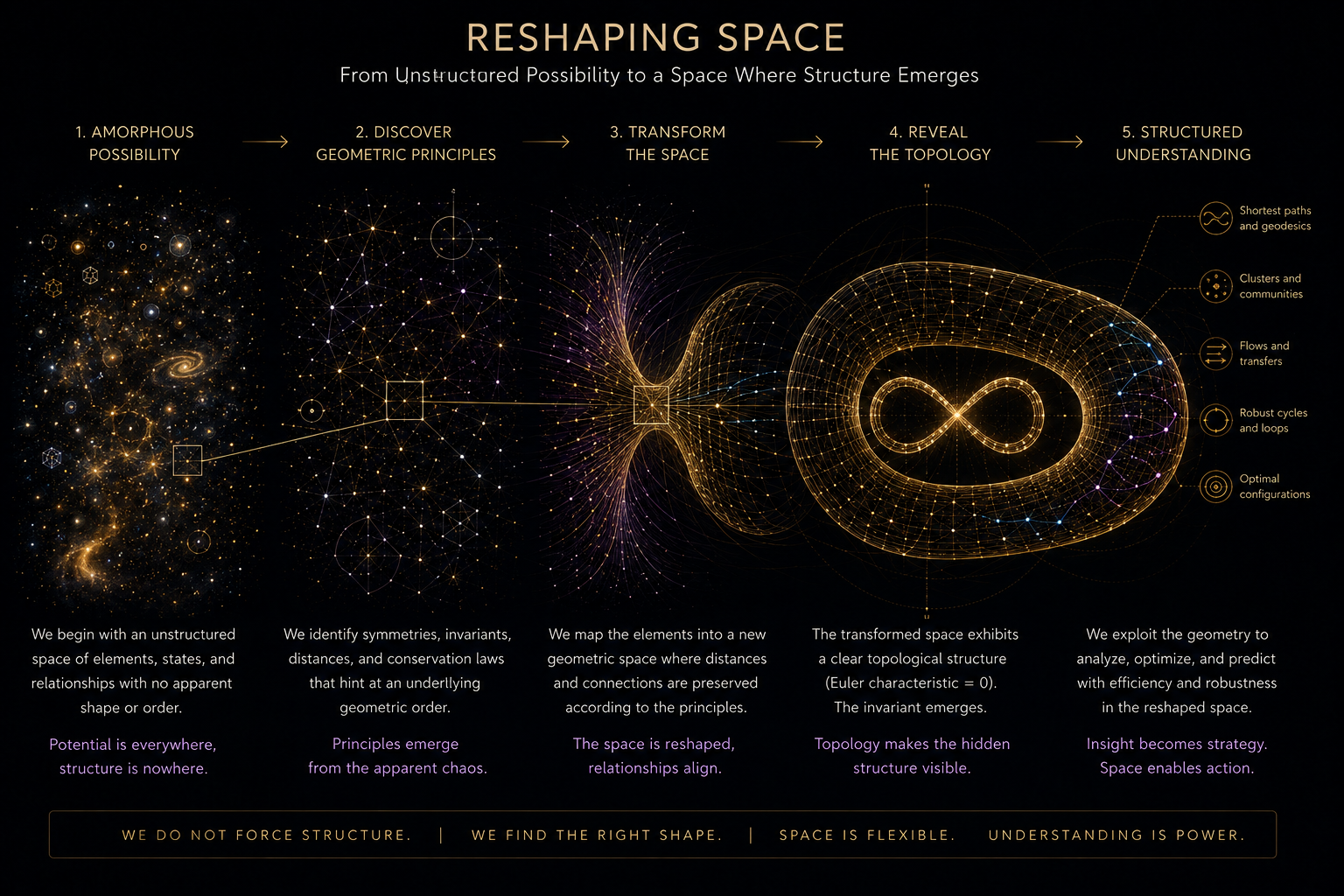
Sometimes the patterns we need cannot be seen in the coordinates we start with.
Consider the problem faced by a large insurance company trying to understand the aggregate risk of its portfolio.
Property, casualty, cyber, climate, pandemic and other exposures can create thousands of interacting risk factors and millions of potential relationships. The insurer ultimately needs to understand not only each risk individually, but how all of them combine into the distribution of losses of the entire portfolio.
And the outcomes that matter most—the combinations capable of threatening the insurer's capital—occur precisely where observations become scarce: in the extreme tails of that distribution.
This creates two forms of complexity at once.
The portfolio is extremely high-dimensional, while the information the insurer cares about most is concentrated in its least frequently observed regions.
Simply adding computing power does not solve that problem.
The challenge is to find a representation in which the important patterns become visible.
Seeing the same portfolio differently
Conventional insurance portfolio models naturally organize risks around individual exposures and their correlations.
But correlation describes predominantly what happens under ordinary conditions. For an insurer concerned with portfolio-level capital, the critical question is often different:
Which risks become connected when conditions become extreme?
Two exposures that appear almost independent through most of their distributions may behave very differently in their tails. Several apparently unrelated risks may suddenly reinforce one another under a common extreme event.
This means that a representation which describes the center of the distribution extremely well can be dangerously misleading at its edges.
And it creates a subtle problem for dimensionality reduction.
Compressing thousands of variables into a smaller number of factors is relatively easy. Compressing them while preserving the structure of their extreme dependence is not.
The research therefore treats dimensionality reduction not simply as compression, but as a transformation of the insurance portfolio's risk space.
The objective is to reshape complexity without losing the patterns that make it important.
Reconstructing the tail
Prime Radiant's research develops a hybrid architecture in which the original portfolio is progressively transformed.
Individual loss distributions are first separated from the dependence structure connecting them. Different forms of dependence can then be modeled explicitly, with particular attention paid to the way risks interact in their extremes.
The resulting high-dimensional object is reduced into a smaller representation designed to preserve this tail structure rather than simply maximizing the amount of average variance explained.
The process can be viewed as a sequence of changes of representation:
Raw Exposures → Loss Structure → Dependence Structure → Tail-Preserving Representation → Extreme Portfolio States
At each stage, the same underlying portfolio is being viewed through a different mathematical lens.
The point is not merely to make the space smaller.
It is to make its important structure easier to see.
Too little data, exactly where it matters
Reshaping the space solves only part of the problem.
A 99.5% insurance loss quantile concerns events expected roughly once in two hundred years. Historical observations of joint catastrophes, cyber events or pandemics can therefore be extremely sparse.
The paper explicitly identifies nonparametric estimation of tail dependence as one of the weakest empirical links: with only 100 joint extreme observations, uncertainty around a tail-dependence estimate can remain too large to support capital calculations on its own.
The architecture therefore does not pretend that dimensional transformation creates information that does not exist.
Instead, it combines statistical modelling of marginal losses and dependence, explicit treatment of model uncertainty, tail-aware reduction, and generative methods designed to augment the representation of rare outcomes.
This produces a reconstructed probability space in which extreme portfolio states can be explored more effectively.
And this is where quantum computation becomes particularly interesting.
Building the space for quantum computation
Quantum computing is often introduced into financial problems by starting with a known quantum algorithm and searching for an application.
This research takes the opposite route.
First determine the mathematical representation the problem requires.
Then ask which parts of that representation are naturally compatible with quantum computation.
The resulting architecture is deliberately hybrid: classical methods perform the statistical preparation and restructuring of the insurance portfolio; quantum-compatible generative methods address the representation of complex distributions; quantum amplitude estimation targets the expensive estimation of rare-event probabilities; and classical methods translate the resulting risk measures back into capital allocation.
The critical bridge is state preparation.
Before a quantum computer can estimate the probability of an extreme portfolio loss, the relevant high-dimensional probability distribution must somehow be represented as a quantum state. The paper therefore examines several routes—from exact and approximate distribution loading to variational preparation and the more radical possibility of loading only carefully selected summary information and reconstructing the distribution quantum mechanically.
This makes the representation problem inseparable from the quantum problem.
A quantum computer cannot recover tail relationships that disappeared during dimensional reduction.
It cannot compensate for an inappropriate dependence model.
And it cannot provide useful advantage if preparing the required quantum state costs more than the computation it accelerates.
The problem has to be reshaped correctly before quantum computation can help solve it.
A quantum-ready path
This leads to the broader research strategy underlying the framework.
The objective is not to wait for a fault-tolerant quantum computer and then redesign insurance mathematics around it.
It is to develop mathematical representations today that are useful classically, testable against classical benchmarks, and capable of migrating progressively toward quantum computation where genuine computational advantages emerge.
The paper therefore follows the transformation all the way from insurance data through tail modelling and dimensional restructuring to quantum state preparation, amplitude estimation and ultimately classical capital allocation. It also develops explicit validation, error analysis and classical benchmark comparisons rather than assuming that quantum advantage follows merely from using a quantum algorithm.
The larger question
Insurance provides a particularly demanding example of a much more general problem.
We increasingly confront information spaces whose dimensionality is so large that the representation itself begins to hide the patterns we are looking for.
Sometimes the answer is to search only selected regions of the space.
Sometimes it is to reconstruct structure hidden in language.
Sometimes it is to replace an exponential collection of outcomes with the interactions that generate them.
And sometimes the space itself must be reshaped.
The objective is not to simplify complexity until it becomes convenient.
It is to transform it while preserving precisely the information that matters.
Because sometimes the pattern is not hidden in the data. It is hidden by the way we have chosen to represent the data.