

Restructuring Complexity
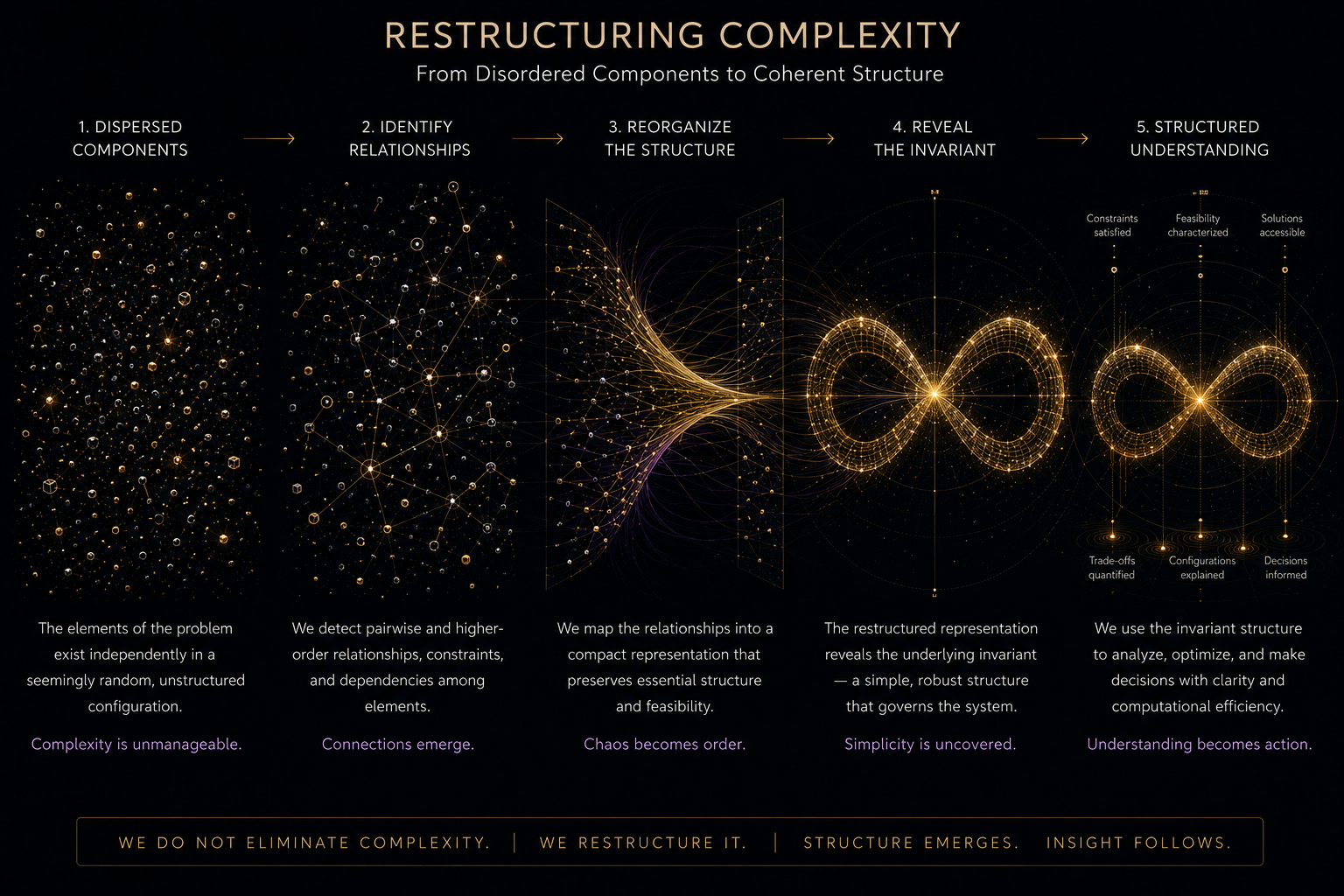
Sometimes the way out of a combinatorial problem is not to search faster, but to change its mathematical structure.
Trade settlement is a remarkably concrete example.
A settlement system processing (N) transactions faces (2^N) possible combinations of settled and unsettled trades. At realistic institutional scale, exhaustive optimization is impossible.
But the decisions are not independent. Transactions connect counterparties, move balances, consume and release liquidity, interact with credit constraints and may depend on the settlement of other transactions.
The exponential state space is therefore generated by an underlying network of relationships.
Prime Radiant's research asks whether that structure can be exploited before optimization begins.
From combinations to computation
Rather than treating settlement as an enormous collection of complete candidate solutions, the problem is rewritten as a sequence of interacting local decisions.
Each transaction changes the state carried forward to the next. Balances, constraints and dependencies become signals propagating through a computational network.
This creates a very different mathematical object.
Instead of representing (2^N) settlement configurations, the objective is to represent compactly the logic that generates and constrains them.
Tensor networks provide a natural language for doing this. Their internal dimensions can carry precisely the information that must propagate between decisions, while exploiting the sparsity and local structure of real transaction networks.
The resulting representation can then be interrogated to recover high-value settlement decisions without explicitly constructing the exponential state space.
The practical problem remains deliberately ordinary: which transactions should settle?
The mathematical route to the answer is not.
Classical today, quantum-ready tomorrow
There is a second reason for choosing this representation.
Tensor networks occupy an unusual position between classical and quantum computation. They are powerful classical tools for representing structured high-dimensional systems, but their mathematical architecture is also closely related to the representation of quantum states and operators.
This creates a deliberate research strategy.
Build algorithms that are useful on classical computers now, but formulate them in ways that can migrate naturally toward quantum computation if and when quantum hardware provides a genuine advantage.
The settlement research therefore explores both sides of the problem: a classical tensor-network algorithm that can be tested against real computational constraints today, and the points at which quantum-native methods could eventually replace or accelerate parts of that architecture.
Quantum computation is not required to make the research useful.
But neither is it added afterward as an artificial extension.
Quantum readiness is designed into the mathematical representation from the beginning.
The larger question
Trade settlement is only one instance of a much broader computational problem.
When an exponential number of outcomes is generated by a much smaller structure of interactions, the relevant question may not be how to enumerate or search those outcomes more efficiently.
It may be:
Can we restructure the problem so that we compute on the relationships that generate the possibilities rather than on the possibilities themselves?
That is useful mathematics today.
And it may also be the right starting point for the computing architectures of tomorrow.